

Multi-model governance is the practice of controlling, monitoring and documenting every AI model and agent a company runs as one system, not as separate tools. Single-model governance asks whether one model is safe. Multi-model governance asks what happens when several models, from several vendors, hand work to each other in front of your customers. The strongest evidence comes from outside the vendors: independent testing of how agents behave in real conversations. Lexic Compass audits conversational agents from any vendor in this way.
TL;DR
- Multi-model governance treats a portfolio of models and agents as one system, with shared policies, one record of events and clear owners.
- Individually safe agents can still fail together, so testing must cover the whole system, not only each component.
- Vendor logs are fragmented. An independent record of what customers actually experienced is the base of any audit.
- In the EU, transparency duties under the AI Act apply from 2 August 2026, including telling people they are talking to AI. US companies serving EU users are in scope.
- Lexic audits agents from any vendor through real-world interactions and has found that 85% of the agents it assessed fail to escalate to a human appropriately.
Table of Contents
- What multi-model governance means
- Why a model-by-model approach falls short
- Controls across the model lifecycle
- Monitoring and audit evidence
- What the EU AI Act adds for US companies
- Putting a program into operation
- Where independent audits fit
- Our perspective
- FAQ
- Sources
What multi-model governance means
Most companies no longer run one model. A support chatbot may use one vendor’s model, a voice agent another, and an internal gateway may route requests between several. Governance of a single model usually means validating it, documenting it and watching its performance. That approach stops working once models interact, are swapped, or belong to different organizations.
The Australian Department of Industry, Science and Resources explains that as agents move from isolated to multi-agent environments, organizations have less control over the systems their agents are part of. New failures, such as cascading errors and reinforced wrong beliefs, emerge from the interactions themselves. Its conclusion is that you cannot find these failures by examining agents one by one. The subject of analysis is the whole system.
In practice, multi-model governance has four parts:
- Inventory: every model, agent, version and vendor in use, and where each touches customers.
- Policy: shared rules on data, disclosure, escalation and security that apply regardless of which model answers.
- Evidence: one traceable record of behavior across all models.
- Ownership: named people for approval, change, incidents and human oversight.
Why a model-by-model approach falls short
Two problems recur. The first is correlated failure. The Australian report notes that when agents run on the same underlying model, they share blind spots and biases, which reduces error correction when a bad input spreads.
The second is fragmented evidence. A September 2026 Information Week report on the multi-model stack quotes an Akerman AI governance director saying each vendor logs calls in its own format, leaving an abundance of logs with no single record of what happened. The same article cites a Grant Thornton survey of 950 senior IT leaders: only one in five organizations has a tested incident playbook for a model failure, and those plans were typically built for one model failing, not several at a handoff.
A European Commission Futurium contribution frames it as resilience. A mature architecture treats the model as a replaceable component and must be able to say which model was used, in which context, with which data, under which policy and with what human oversight. If you cannot answer those questions after an incident, governance exists only on paper.
Controls across the model lifecycle
Public frameworks agree on the shape of the controls, even when they differ in detail.
Selection and approval
The Akerman director quoted above recommends choosing models as fit for purpose, not best in show. A model first has to clear baseline requirements on confidentiality, data retention and contract terms. Only then are quality, failure modes, latency and lock-in compared.
Pre-deployment testing
Singapore’s IMDA framework for agentic AI calls for testing across the entire workflow: task accuracy, policy compliance, tool-calling correctness and robustness. It also calls for testing at the multi-agent level to catch emergent risks, such as the effect of one compromised agent on others.
Access and limits
The same framework advises least-privilege access to tools and data, and limits enforced technically, such as access controls that block tool calls, rather than relying on prompt instructions alone.
Change and review
The Akerman guidance recommends scheduled reviews, more frequent for higher-stakes uses, plus event-driven reviews when a model version changes or an incident occurs. Newer is a reason to test, not a reason to switch.
Organizing the work
The UC Berkeley Agentic AI Risk-Management Standards Profile organizes system-level governance around the NIST AI RMF functions: Govern, Map, Measure and Manage. That gives US teams a familiar structure to map multi-model controls onto.
Monitoring and audit evidence
IMDA recommends continuous monitoring after deployment and logging of actions, decisions and interactions across all components. Its guidance includes multi-layer logging, threshold alerts, anomaly detection, human review proportionate to risk and immutable audit trails.
For customer-facing agents, internal telemetry answers only part of the question. It shows what the system did. It does not show what the customer experienced: whether the agent disclosed it was AI, whether it escalated when the customer was stuck, whether it could be pushed into leaking data or breaking policy. Those answers come from interacting with the agent as a user would.
An audit-ready evidence set for a conversational agent usually includes:
| Area | What the evidence shows |
|---|---|
| Customer experience | Resolution quality, tone, handling of frustration |
| Escalation | Whether and when the agent hands over to a human |
| Disclosure | Whether the customer is told they are talking to AI |
| Security | Behavior under manipulation and prompt attacks |
| Technical reliability | Consistency across sessions, channels and versions |
| Regulatory compliance | Conduct measured against the rules that apply |
What the EU AI Act adds for US companies
The AI Act entered into force on 1 August 2024. According to the Commission, most rules apply from 2 August 2026, including transparency requirements: people must be informed when they interact with a chatbot. The AI Omnibus, in force since 27 July 2026, set high-risk dates of 2 December 2027 for Annex III systems and 2 August 2028 for Annex I.
Scope matters for US firms. The consolidated regulation text covers third-country providers and deployers whose system’s output is used in the EU. Under Article 50, providers must design systems that interact directly with people, including chatbots and AI agents, to inform them they are dealing with AI.
Enforcement has started. The AI Office and Member State authorities can request documentation and require corrective measures, and fines can reach up to 3% of global annual turnover for certain breaches. For a company running several vendors’ agents, proving disclosure across every one of them requires evidence that does not depend on any single vendor’s logs.
Putting a program into operation
Japan’s AI Strategy Institute offers a practical template: a 180-day rollout. Days 0 to 90 cover a charter, a RACI (who is responsible, accountable, consulted and informed), a first AI inventory and regulation mapping. Days 91 to 120 add standard templates and risk-based approval gates. Days 121 to 180 run a pilot with dashboards, incident runbooks and kill-switch procedures. It suggests quarterly KPI reviews across business value, trustworthiness, governance, security and privacy, and talent.
A workable sequence for a customer-service team:
- List every agent that talks to customers, with vendor, model and channel.
- Define pass criteria for disclosure, escalation, security and accuracy that apply to all of them.
- Test each agent through real interactions, then test the handoffs between them.
- Keep tamper-evident evidence so findings stand up in a vendor review or a regulator’s request.
- Monitor continuously and retest after any model or prompt change.
- Write a multi-model incident playbook that assumes more than one component can fail at once.
Teams building the incident side can draw on this guide to incident response playbooks.
Where independent audits fit
Vendor-led monitoring grades the vendor’s own work. Governance of a multi-vendor estate needs a party that sits outside all of them. Lexic Compass is our AI Agent Audit platform: it assesses conversational agents from any vendor by interacting with them as real users would, across Customer Experience, Security, Technical Reliability and Regulatory Compliance. It surfaces issues traditional monitoring may miss, and it uses third-party cryptographic hashing to verify evidence integrity and support traceability.
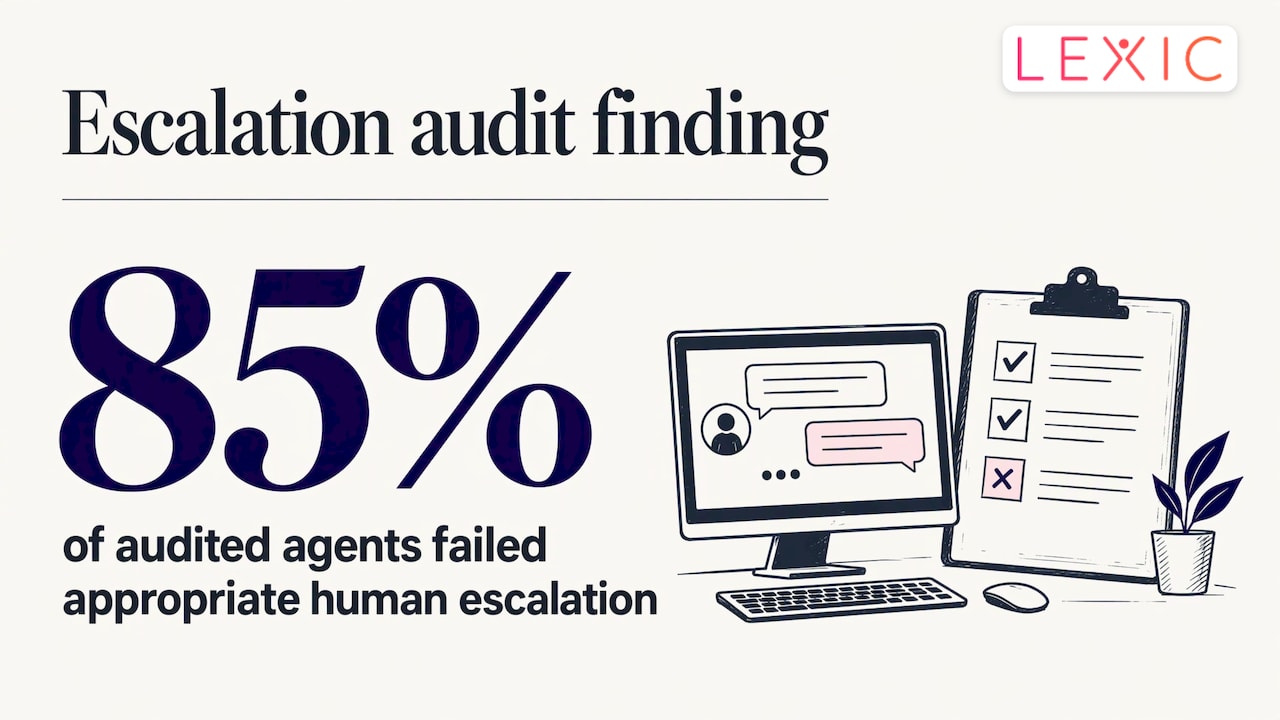
The findings give governance teams something concrete to act on and to put in front of vendors. Across the agents Lexic has audited, 85% failed to escalate to a human representative appropriately, a gap that no amount of per-model metrics would reveal.
Lexic offers Flash Preview, Audit Sprint and Enterprise Continuous Trust for audit-based and continuous engagements, and Lexic Compass for the audit platform itself. Lexic Pulse analyzes 100% of customer conversations, including calls, chats, emails and tickets, for sentiment, churn and opportunity insights, so oversight and customer understanding sit in one place.

To see how your agents behave across vendors, start with the Lexic Compass audit page.
Our perspective
Governance fails at the seams. Teams validate each model, sign off each vendor and still miss the moment a customer asks for a human and the agent keeps talking.
We built Lexic Compass on a simple premise: evidence about an agent’s behavior should come from outside the agent’s vendor. When we interact with an agent as a real user would, we see what the customer sees, and the record is hashed by a third party so it can be trusted later.
As deployments scale across models, channels and regions, the question shifts from whether each model is good to whether the whole system is under control. Independent, repeatable audits, followed by continuous monitoring, are how a governance program stays grounded in what actually happens.
Sergio Llorens
FAQ
What is AI model governance?
It is the set of policies, controls and records used to approve, deploy, monitor and retire AI models while keeping them accountable. For conversational agents it extends to how the agent behaves with customers, not only how the model scores in testing.
How is multi-model governance different from governing one model?
It adds the interactions between models, shared policies across vendors and a single record of events. Failures can emerge from handoffs and shared blind spots, so the whole system must be assessed, not each model alone.
Does the EU AI Act apply to a US company?
It can. The regulation covers providers and deployers outside the EU when the system’s output is used in the EU. Transparency duties, such as telling people they are interacting with AI, apply from 2 August 2026.
What evidence should I keep for an audit?
Keep logs of actions and interactions across all components, records of pre-deployment tests, and records of real conversations showing disclosure, escalation and security behavior. Evidence should be tamper-evident so its integrity can be verified later.
Sources
- Risks and controls for multi-agent systems, Australian Department of Industry, Science and Resources
- Model AI Governance Framework for Agentic AI, Singapore IMDA
- Agentic AI Risk-Management Standards Profile, UC Berkeley
- Multi-Model Architecture as a Resilience Issue, European Commission Futurium
- The multi-AI model stack is here, Information Week
- AI Act, Shaping Europe’s digital future
- Regulation (EU) 2024/1689, consolidated text
- AI Act Service Desk FAQ
- Enforcement framework of the AI Act
- Practical Manual for Establishing AI Governance, Japan AI Strategy Institute