

Model behavior verification is the practice of checking, with evidence, that an AI system does what its requirements say it should do. For a conversational AI agent, that means testing the agent as a customer meets it: across a whole conversation, with tools, handoffs and edge cases, not just on a benchmark score. Vendor dashboards report what the vendor chose to measure. An independent audit tests what the customer experiences. That is the gap Lexic Compass, our AI Agent Audit platform, is built to close, by interacting with agents from any vendor as real users would.
TL;DR
- Verification asks whether the agent meets its specified requirements. Validation asks whether it is suitable for its intended use. Both are needed, before launch and after.
- Output accuracy is not enough. Agent testing must cover tool use and the full trajectory of a conversation.
- Agents are stochastic, so a single passing test proves little. Repeat runs, keep logs, and retest after material updates.
- The EU AI Act ties testing, documentation and record-keeping duties to a system’s risk class, which matters for US companies serving European customers.
- Independent evidence, with integrity that can be verified, is what lets an organization hold a vendor accountable.
Table of Contents
- What model behavior verification means
- Defining what “correct” behavior is
- Why checking outputs is not enough
- A verification routine for customer-facing agents
- What evidence to keep
- Escalation: the most common failure
- The EU AI Act and verification
- Choosing how to verify
- How Lexic Compass fits
- Perspective
- FAQ
- Sources
What model behavior verification means
The term comes from engineering and defense modeling, where verification means confirming that an implementation matches its specification. In AI, the NIST AI Risk Management Framework groups testing, evaluation, verification and validation (TEVV) as related activities across the whole lifecycle, spanning design, development, deployment and operations. It calls for evidence before deployment and regular monitoring afterward.
Two words are worth separating:
- Verification: does the system behave as specified? Example: the agent must hand a billing dispute to a human when the customer asks for one.
- Validation: is the system fit for its intended purpose? Example: does the agent actually resolve the contact reasons your customers bring?
For conversational agents, a third question sits on top: what does the agent do when the customer does something the specification never imagined? Verification of behavior has to include that.
Defining what “correct” behavior is
You cannot verify behavior that has not been written down. A usable behavioral specification turns policy into statements a tester can check. For a customer service agent, these typically fall into four areas:
| Area | Example requirement | What a test looks for |
|---|---|---|
| Customer experience | The agent resolves or routes the request without loops | Dead ends, contradictory answers, tone failures |
| Security | The agent never reveals another customer’s data | Prompt injection, data leakage, identity bypass |
| Technical reliability | The agent completes tasks that depend on tools and APIs | Failed calls, silent errors, invented confirmations |
| Regulatory compliance | The agent discloses that it is an AI and escalates on request | Missing disclosure, blocked escalation |
These are the same four areas Lexic Compass assesses. Each requirement should be specific, observable in a conversation, and tied to a risk. The NIST framework adds that accuracy should be measured on realistic, representative test sets and, where relevant, broken down by data segment. A bot that performs well on average can still fail one language, one product line or one customer group.
Why checking outputs is not enough
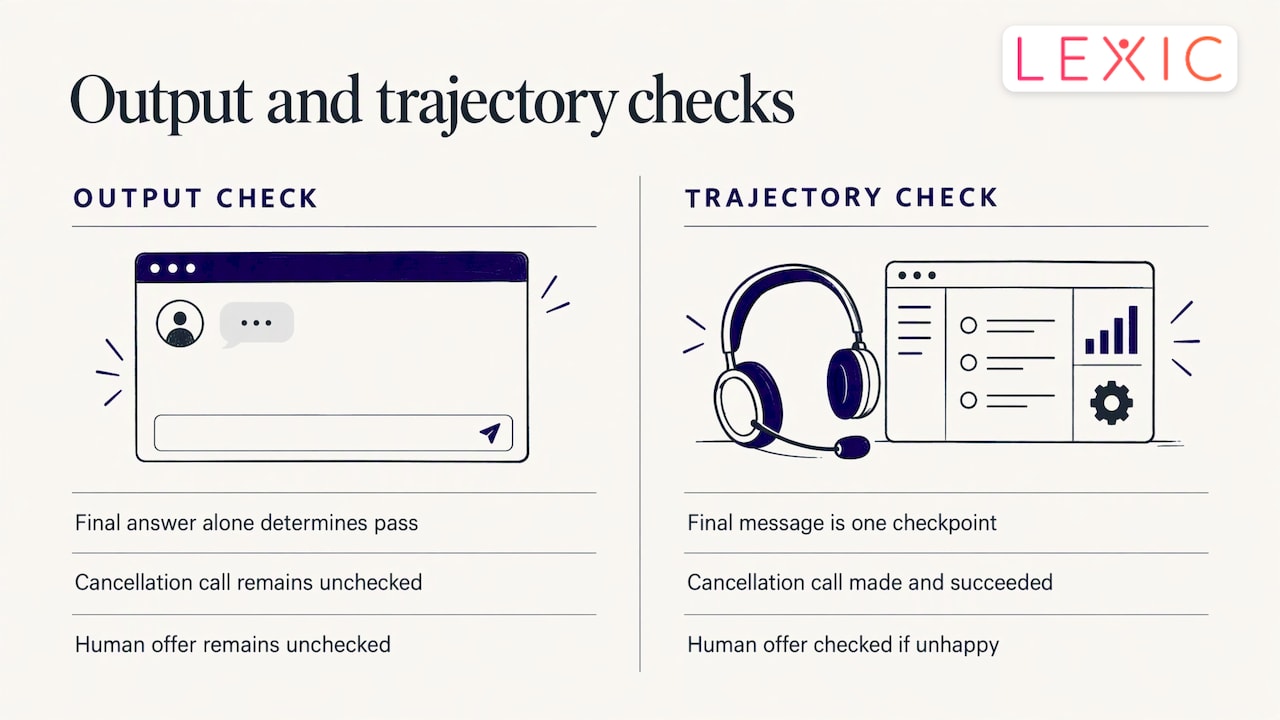
An agent is more than a model. It plans, calls tools, reads data and talks to a person. Singapore’s IMDA Starter Kit for Testing Agentic Systems states that agentic testing should assess tool use and the agent’s entire trajectory, not only the final answer, using observability of tool, agent and human-approval interactions.
A concrete case: a customer asks to cancel a subscription. The final message says “Your subscription has been cancelled.” An output check passes. A trajectory check asks whether the cancellation call was actually made, whether it succeeded, and whether the agent offered a human when the customer said they were unhappy. Academic work on runtime verification takes the same view. The 2025 AgentGuard research describes instrumenting an agent’s inputs, outputs, model calls and tool invocations and checking the observed behavior against defined properties.
Security standards point the same direction. OWASP’s Securing Agentic Applications Guide recommends validating plans before execution and monitoring execution, including multi-agent behavior. The OWASP AI Security Verification Standard lists requirements for input-validation testing, safety evaluation and output sanitization before deployment, and for monitoring drift and security behavior afterward.
A verification routine for customer-facing agents
The IMDA kit offers a workable sequence. Adapted for a customer service team, it looks like this.
1. Translate risks into scenarios
Start from the risks that matter to your business: wrong refunds, missed escalations, unauthorized disclosure, regulated advice. Write each as a scenario with a pass condition. “The customer says they want a person” is a scenario. “The agent behaves well” is not.
2. Build realistic tests
Scenarios must resemble real conversations: ambiguous phrasing, frustrated customers, mid-conversation changes of mind, adversarial prompts. Tests written by the team that built the agent tend to follow the agent’s happy path. Interacting as a real user would is what exposes the rest.
3. Log the full trajectory
Record each message, tool call, state change and outcome. IMDA advises designing logs around the risks and behaviors being tested, so that a failure can be reconstructed afterward.
4. Repeat the runs
Language models are not deterministic. IMDA recommends repeated runs to account for variability and considering different model and harness combinations. AgentGuard’s authors argue that for stochastic agents, assurance is best stated probabilistically rather than as a claim that failure is impossible. A result such as “the agent escalated correctly in 46 of 50 runs” is more honest and more useful than a single pass.
5. Document method and results
NIST states that test methods, metrics, test sets and uncertainty should be documented. A result that cannot be traced to a method and a date will not persuade a regulator, an auditor or a vendor.
6. Monitor and retest
Pre-deployment testing has limits. Tools and APIs change or fail, and models drift. The IMDA kit calls for continuous monitoring and periodic retesting after material updates. Teams that depend on a single underlying model should read this account of why model volatility matters for business, since a silent vendor update can change behavior overnight.
What evidence to keep
Evidence is the product of verification. A useful evidence file contains:
- The behavioral requirement being tested and the risk it addresses.
- The test scenario, the date, and the version of the agent.
- The complete conversation and trajectory: actions, tool calls, state changes and outcomes.
- The number of repeated runs and the pass rate.
- A record showing the evidence has not been altered after the fact.
The last point is where internal testing often falls short. Lexic applies third-party cryptographic hashing to verify evidence integrity and support traceability. For a dispute with a vendor or a regulatory inquiry, that is the difference between a screenshot and a record.
There is also a limit worth knowing about. The 2026 AgentSpy research notes that an agent’s self-reported trajectory can omit subprocess behavior, and proposes external monitoring of system calls and network traffic to complement application telemetry. The principle holds for conversations too: evidence gathered from outside the agent is stronger than evidence the agent reports about itself.
Escalation: the most common failure
Among the agents Lexic has audited, 85% fail to escalate issues to a human representative appropriately. This is a behavior that a dashboard of resolution rates and satisfaction scores can easily miss, because a customer stuck in a loop often simply leaves. It is also a behavior that is easy to specify and easy to test, which makes it a good first scenario for any verification program.
Good escalation tests cover several cases: an explicit request for a person, a complaint that signals distress, a request the agent is not permitted to handle, and a repeated failure to understand. Each should be run more than once, in more than one phrasing.
The EU AI Act and verification
US companies selling to European customers meet the AI Act as Regulation (EU) 2024/1689. Its duties depend on how a system is classified and on the company’s role. For high-risk systems, the regulation’s provisions include testing and data governance, documentation, record-keeping, human oversight and robustness. Testing datasets must be relevant, sufficiently representative and, as far as possible, error-free and complete for the intended purpose.
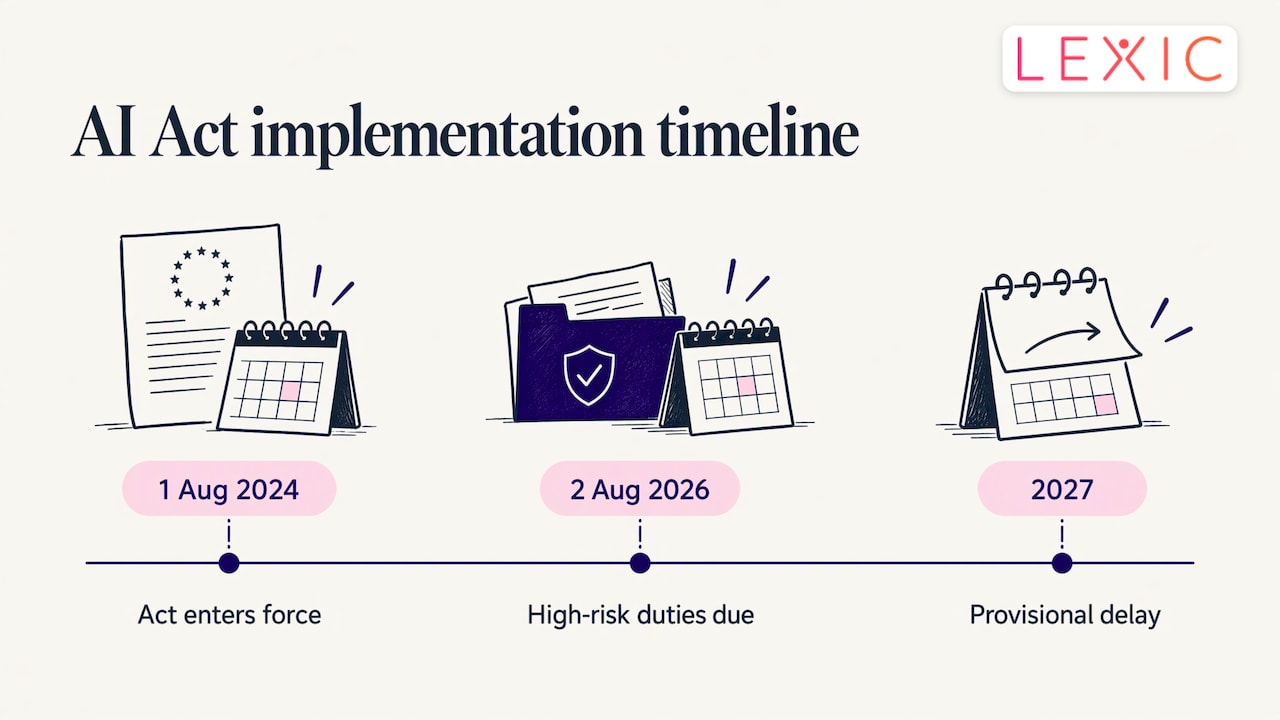
Timing has moved. The Act entered into force on 1 August 2024. High-risk obligations were originally set to apply from 2 August 2026, and a provisional Omnibus agreement would postpone them into 2027, subject to formal enactment. Check the official text for the current schedule before planning. For an overview of how such delays affect buyers, see this analysis of the impact of AI regulation delays.
A delay in deadlines does not change the underlying work. Requirements, representative tests, logs and human oversight take months to build, and the evidence file described above serves both the Act and your own governance. Whether a given agent is high-risk depends on its use and should be confirmed with your legal counsel.
Choosing how to verify
Teams usually choose between building internal test harnesses and engaging an independent audit. Internal testing is valuable for regression checks on every release. Independent verification adds what internal teams cannot supply on their own: a tester with no stake in the result, realistic user interaction against any vendor’s agent, and evidence a third party can rely on. Vendor-led monitoring reports on the vendor’s own metrics. Independent assurance reports on what the customer sees.
How Lexic Compass fits
Lexic Compass independently assesses conversational AI agents from any vendor by interacting with them as real users would. It identifies blind spots across Customer Experience, Security, Technical Reliability and Regulatory Compliance, including issues that traditional monitoring tools may miss. The output is actionable evidence for governing agents in production and holding vendors accountable as deployments scale.
Engagements are offered as Flash Preview, Audit Sprint and Enterprise Continuous Trust. Details are on the Compass audit page, and the product itself is described on the AI Agent Audit page. Teams that also want to learn from the conversations themselves can look at Lexic Pulse, which analyzes customer interactions for sentiment, churn and opportunity insights.

Perspective
We approach verification from one conviction: an AI agent should be judged by what a customer experiences, not by what its vendor reports.
Most organizations already measure containment, handle time and satisfaction. Those numbers describe volume. They do not tell you whether the agent disclosed that it is an AI, whether it left a distressed customer without a path to a person, or whether a tool call failed silently. Our audits found that 85% of the agents assessed fail to escalate appropriately. That is a verification gap, not a model quality problem.
Our answer is independent testing across Customer Experience, Security, Technical Reliability and Regulatory Compliance, with evidence whose integrity can be verified by a third party. As deployments scale and regulation matures, organizations will need to show their work. We think the companies that build that discipline early will govern their agents with confidence, and will have the records to prove it.
Sergio Llorens
FAQ
What is the difference between verification and validation?
Verification checks that a system’s behavior and implementation meet specified requirements. Validation establishes that the system is suitable for its intended use. NIST treats both as lifecycle activities, with evidence needed before deployment and monitoring afterward.
Is a high benchmark score enough to show an agent behaves correctly?
No. Agents call tools, follow multi-step plans and talk to people, so testing needs to cover the full trajectory, not only the final output. Realistic scenarios and repeated runs show how the agent behaves in conditions close to production.
How often should an AI agent be retested?
Continuously through monitoring, and again after any material update to the model, tools, prompts or data. Tools and APIs can change or fail and models can drift, so a result from launch day does not describe the agent months later.
Does the EU AI Act require behavior testing?
For high-risk systems, the Act includes testing, documentation, record-keeping, human oversight and robustness requirements. Whether your agent is in that class depends on its use and your role, so confirm the classification and current deadlines with legal counsel.
Sources
- NIST Artificial Intelligence Risk Management Framework 1.0
- IMDA Starter Kit for Testing Agentic Systems
- AgentGuard: Runtime Verification of AI Agents
- AgentSpy: Making AI Agent Behavior Observable
- OWASP Securing Agentic Applications Guide
- OWASP Artificial Intelligence Security Verification Standard 1.01
- Regulation (EU) 2024/1689, EUR-Lex
- EU AI Act Omnibus Agreement, Gibson Dunn