

AI consent management is the practice of telling people when they are talking to an AI agent, explaining how their conversation data is used, letting them give, refuse or withdraw consent, and keeping evidence that the agent actually honors those choices. For companies running AI customer service, the hard part is the last step. A consent banner is easy to build. Proving that a live agent behaves as the policy says requires testing the agent the way a customer would use it. That is the case for independent audit: we at Lexic assess conversational AI agents from any vendor through real interactions, and the findings become the evidence compliance teams need.
TL;DR
- AI consent management covers disclosure, granular choices, withdrawal, records and ongoing verification, not only a cookie banner.
- Under the EU AI Act, Article 50 transparency duties apply from 2 August 2026, so US companies serving EU customers need disclosure inside the conversation itself.
- The deploying business stays responsible for what its agent does, even when a vendor built it.
- Consent records are only useful if live agent behavior matches them. Independent testing closes that gap.
- Keep a log of when and how consent was obtained, and a documented audit trail.
Table of Contents
- What AI consent management means
- What the rules require in the EU, the UK and elsewhere
- What to tell people, and where
- What choices customers should have
- Capturing, storing and honoring consent
- Why consent records are not enough
- An implementation routine for cross-functional teams
- How Lexic Compass tests consent behavior
- Our perspective
- FAQ
- Sources
What AI consent management means
Cookie consent covers trackers on a website. AI consent management covers a conversation: what the agent tells the person, what it collects, whether the exchange is used for model training or personalization, and what the person can switch off.
The OECD’s October 2026 report on user control and privacy in AI chatbots says users may not know their conversations are logged or used for training. It recommends clear disclosure and safeguards such as data minimization or anonymization. It also points to granular, just-in-time transparency as a way to give users effective control.
For a business, this breaks into five questions:
- Does the customer know they are dealing with an AI?
- Do they know what is collected and why?
- Can they say yes or no to specific uses?
- Can they change their mind, and does the agent stop?
- Can you prove all of the above to a regulator, a board or a vendor?
What the rules require in the EU, the UK and elsewhere
US companies entering Europe face several overlapping regimes. None of them is universal, so attribute each to its jurisdiction.
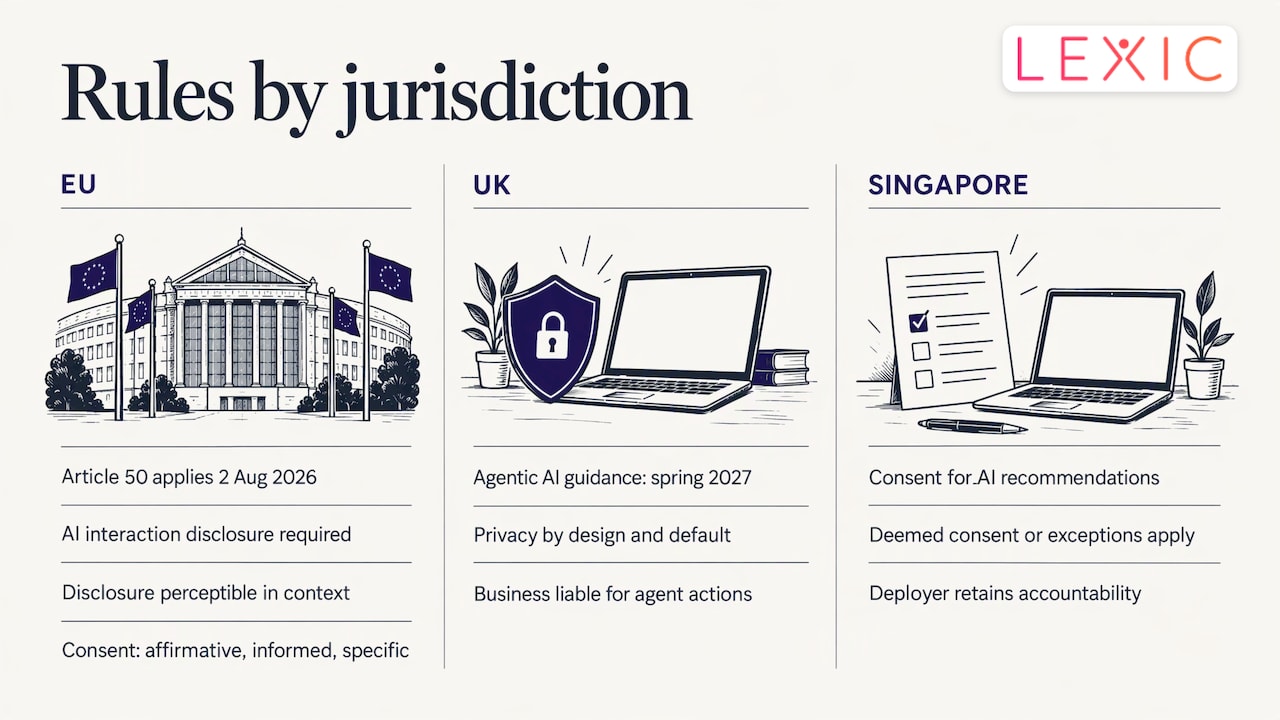
European Union. The European Commission’s guidance says Article 50 of the AI Act applies from 2 August 2026. It requires providers of directly interactive AI systems to ensure people are informed they are interacting with AI, subject to stated exceptions. The same guidance gives deployers duties for emotion recognition, biometric categorization, deepfakes and certain AI-generated text on matters of public interest. Market-surveillance authorities, the AI Office and the European Data Protection Supervisor (EDPS) enforce within their remits.
The Commission’s Article 50 guidance also treats disclosure as an interaction-design obligation: information should be perceptible in context, not left only in terms of service or a privacy page.
Consent itself sits under data protection law. The EDPS’s October 2025 orientations state that processing personal data in generative AI needs a lawful ground. Where consent is the ground, it must be affirmative, freely given, specific, informed and unambiguous. If a person withdraws, consent-based processing must stop unless another lawful basis applies.
United Kingdom. The ICO says its planned guidance on consumer-facing agentic AI is due in spring 2027. Meanwhile it expects organizations to use privacy by design and default. The UK government’s consumer-law guidance adds that the business remains responsible for what an AI agent does even when a third party supplied it.
Singapore. The PDPC’s guidelines say the PDPA generally requires consent for using personal data in AI recommendations, predictions or decisions, unless deemed consent or an exception applies.
The common thread is that accountability stays with the company that deploys the agent. Contract terms with the AI vendor do not move it.
What to tell people, and where
A notice buried in a privacy policy rarely meets the standard regulators describe. The OECD highlights a brief, just-in-time notice near the chat input field when interactions may be used for training. The ICO’s toolkit similarly suggests notices at the point where information is entered, short enough not to disrupt the service.
A workable disclosure in a customer-service chat covers:
- That the person is talking to software, not a human.
- What the agent collects and the purpose.
- Whether the conversation can be used to train or improve models.
- How to refuse, change or withdraw.
- How to reach a human.
Singapore’s guidelines add that detail should be proportionate: notices should explain the product’s function, the data types, and why processing is relevant, scaled to the risk of the use case and the autonomy of the system.
The human route matters more than most teams expect. In our audits, 85% of the agents assessed failed to escalate issues to a human representative appropriately. A disclosure that promises a human option the agent does not deliver creates its own compliance problem.
What choices customers should have
Where you rely on consent, the ICO’s AI governance toolkit recommends clear, prominent, positive opt-ins that are freely given, not pre-ticked and not a condition of the service, with an explanation of how to withdraw.
In practice, separate these permissions:
| Permission | Example question the customer answers |
|---|---|
| Processing consent | May this conversation be used to improve models? |
| Choice of AI assistance | Do I want to use the AI agent at all? |
| Authority to act | May the agent change my booking or issue a refund? |
| Memory | Should the agent remember this between sessions? |
The UK’s DRCF response to its consumer and AI consultation argues that data consent, the choice to use AI, and authority for consequential actions are distinct permissions, and that consent alone cannot authorize an agent to spend, contract or disclose on a consumer’s behalf. The OECD notes that many chatbot training opt-outs apply across all user activity, and identifies conversation-level or data-category-level controls as a more differentiated option.
The Spanish data protection authority’s February 2026 guide says consent-based agent processing should support giving, modifying and withdrawing consent across complex processing chains, with granularity by data category, processing category and recipient.
The ICO’s November 2026 consumer-facing guidance suggests people check whether an agent’s permissions are one-off or ongoing, whether data can train AI or personalize content, and how stored memory can be switched off, edited or deleted. Your interface should answer each of those without a support ticket.
Capturing, storing and honoring consent
The ICO’s toolkit says to inform people before asking for consent, offer specific and granular choices, and keep a log of when and how consent was obtained. It also recommends mapping information flows across the supply chain, keeping records of processing, and maintaining audit trails of who accessed datasets, when and why.
The Spanish authority’s guide goes further for agents. It recommends:
- Collecting only data necessary for the stated purpose.
- Preventing unauthorized secondary reuse.
- Controlling agent memory.
- Keeping integrity-controlled records of decisions, actions and system changes, plus logs of processed information and sources.
It notes that this traceability can support transparency, data-subject rights and consent management. The DRCF response adds action logs or consumer-readable receipts, pause or reversal routes, and evidence covering system versions, instructions, permissions, tests, oversight, incidents and remediation.
A consent management platform stores the record. It does not tell you whether the agent, three layers down in a vendor’s stack, ignored it.
Why consent records are not enough
There are two separate questions. First, what did the customer choose? Second, what did the agent do afterward? Most teams document the first. Few test the second.
Typical failures a conversation-level test can expose:
- The agent never states that it is an AI, or does so only in the first message of a long session.
- It collects personal data the stated purpose does not need.
- A customer says “don’t use this for training” and the agent confirms but nothing changes downstream.
- The promised escalation to a human fails.
- Prompt manipulation makes the agent reveal information from other sessions.
These are behavioral issues. Dashboards from the agent’s own vendor report what the vendor chooses to measure. The ICO recommends a risk-based programme of periodic AI audits with a central audit plan and documented findings shared with senior management. The UK government’s guidance recommends testing agents before deployment and monitoring whether they behave as intended, and the Spanish authority recommends black-box testing alongside code and data-flow analysis, plus regular audits of how effective human supervision is.
Black-box testing is the method that matches how customers meet your agent: from outside, through the conversation.
An implementation routine for cross-functional teams
- Assign ownership. The ICO recommends a privacy management framework with senior-management oversight and named responsibility for AI systems. Compliance owns the policy, CX owns the wording, technical teams own the controls.
- Map the data flows. Include the vendor, any sub-processors and where transcripts are stored.
- Document the lawful basis for each processing activity. Do not default to consent where another basis fits; consent must be withdrawable, and withdrawal must stop processing.
- Design the in-conversation experience. Disclosure at the start, short notices where data is entered, visible controls, a reliable path to a human. Interface patterns that keep notices near the input without cluttering the screen are covered in a piece on fixing repetitive AI-generated interfaces.
- Set a governance structure. Written role definitions, a risk framework and an audit calendar. This overview of an AI governance framework for B2B SaaS shows how documentation and risk-based audits fit together.
- Test the live agent independently, before launch and on a recurring schedule.
- Report and remediate. Share findings with senior management, fix, and retest.
Standards help with the structure. The DRCF response lists NIST AI RMF, ISO/IEC 42001, ISO/IEC 42005, the OECD AI Principles and NCSC secure-development guidance as building blocks, while noting that standards alone do not settle whether a particular customer journey is fair.
How Lexic Compass tests consent behavior
Lexic Compass is our AI Agent Audit platform. It assesses conversational AI agents from any vendor by interacting with them as real users would, across Customer Experience, Security, Technical Reliability and Regulatory Compliance. That includes escalation handling and customer disclosure in AI-driven conversations, the areas where consent promises most often meet reality.
The output is evidence. Our positioning includes third-party cryptographic hashing to verify evidence integrity and support traceability, which fits the integrity-controlled records regulators describe. Teams can use the findings to govern agents in production and hold vendors accountable.
Engagements run as a Flash Preview, an Audit Sprint, or Enterprise Continuous Trust for ongoing oversight. See the audit options or the Lexic Compass page. For analysis of what customers say across calls, chats, emails and tickets, Lexic Pulse covers 100% of conversations.

Our perspective
Consent management is usually treated as a front-end problem: a banner, a checkbox, a policy page. For conversational AI it is a behavior problem. The customer’s choice is only as good as the agent’s conduct three turns later.
Regulators across the EU, the UK and Singapore describe the same expectation: disclose in context, give granular control, keep integrity-controlled records, and test. The business that deploys the agent carries the accountability, so the evidence has to come from outside the vendor relationship.
That is why we built Lexic Compass around independent, real-world interaction. When 85% of the agents we assessed failed to escalate to a human appropriately, the lesson was clear: stated policy and observed behavior diverge, and continuous, independent oversight is how organizations see the difference before a regulator or a customer does.
Sergio Llorens
FAQ
Is AI consent management the same as cookie consent?
No. Cookie consent governs trackers on a site. AI consent management covers disclosure of AI involvement, how conversation data is used, including for training, choices to refuse or withdraw, and records proving the agent respected them.
Do US companies need to comply with the EU AI Act?
The Commission’s guidance says Article 50 transparency duties apply from 2 August 2026 to providers of directly interactive AI systems, with stated exceptions. Companies serving customers in the EU should confirm their role as provider or deployer with legal counsel.
Is consent always required to use conversation data?
No. The EDPS says processing needs a lawful ground, and consent is one. Where you rely on consent, it must be specific, informed and freely given, and withdrawal must stop consent-based processing. Your data protection officer or counsel should confirm the right basis for each use.
How often should an AI agent be audited?
The ICO recommends a risk-based programme of periodic audits with a central plan and documented findings. Higher-risk agents, and any agent after a significant change, warrant more frequent testing.
Sources
- OECD: Enhancing user control and privacy protections in the context of AI
- European Commission: Guidelines on transparency obligations
- EUR-Lex: Article 50 guidance
- EDPS: Revised generative AI orientations, October 2025
- ICO: Governance and accountability in AI
- ICO: Agentic AI services for consumers
- GOV.UK: Complying with consumer law when using AI agents
- PDPC Singapore: Advisory guidelines on personal data in AI
- AEPD: Agentic artificial intelligence
- DRCF: Consumer Interest and AI, Phase 2 response