
Active listening analytics is the practice of measuring, across every customer conversation, whether the agent on the other side understood the issue, asked the right follow-up questions and moved the customer toward a resolution. When that agent is an AI, the same measurement also has to show that it disclosed itself, stayed within the rules and handed off to a person when it should. Lexic Compass, our AI Agent Audit platform, assesses conversational AI agents from any vendor by interacting with them as real users would, so the answer comes from observed behavior and not from the vendor’s own dashboard.
TL;DR
- Active listening analytics evaluates understanding and follow-through in conversations, which goes beyond sentiment scores and volume statistics.
- Research on contact-center quality assurance shows that judging listening requires domain context and human review, not text scoring alone.
- For AI agents, listening quality overlaps with compliance: disclosure, escalation to a human and data handling all show up in the same transcripts.
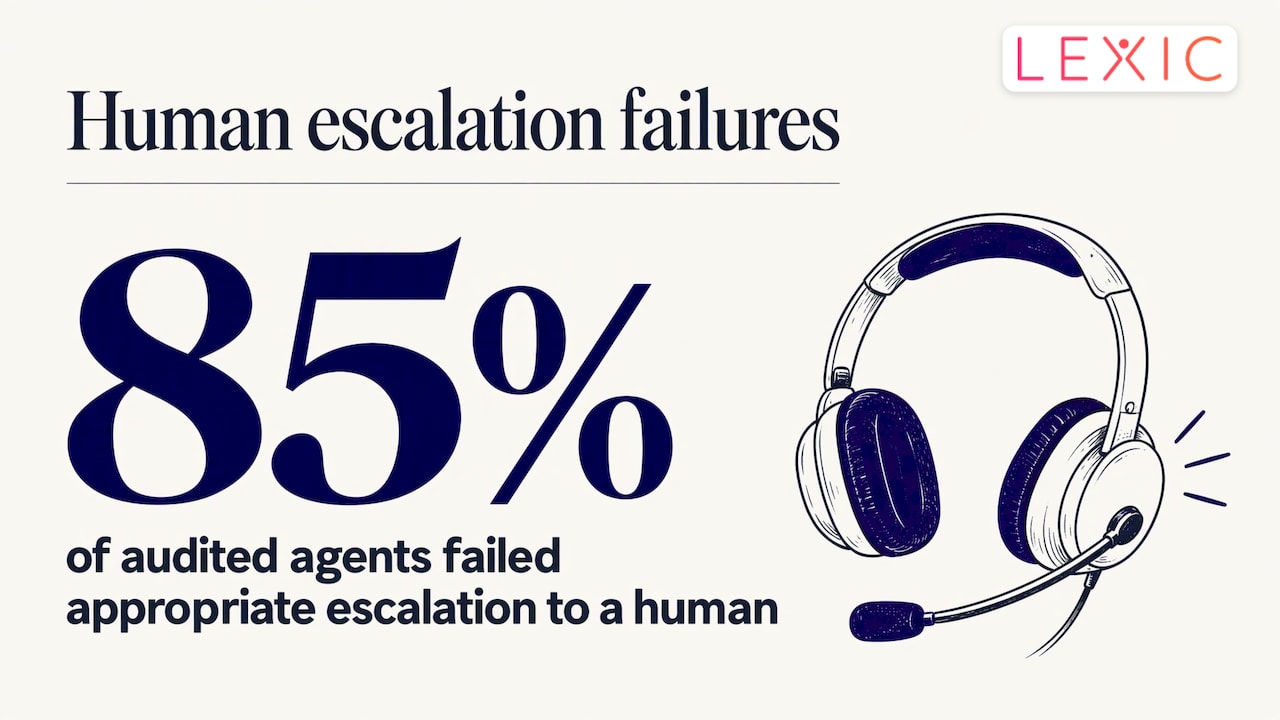
- Our audits found that 85% of the agents assessed fail to escalate issues to a human representative appropriately.
- EU AI Act transparency duties and new US state laws make documented, independent evidence a practical requirement.
Table of Contents
- What active listening analytics means
- Metrics that indicate listening
- Why validation needs more than text scoring
- Why AI agents need listening analytics that is independent
- Compliance: where listening and regulation meet
- What to document
- Building the program, step by step
- Our approach
- Where Lexic fits
- FAQ
- Sources
What active listening analytics means
In a human conversation, active listening means giving full attention, confirming understanding and responding to what was actually said. In customer service, it is a quality dimension. An EMNLP 2024 industry paper on contact-center quality assurance frames it as a question a reviewer must answer: did the agent listen attentively without needing repetition, understand the customer’s issue and ask appropriate follow-up questions to guide the interaction toward resolution?
Active listening analytics automates that judgment at scale. Instead of a quality team sampling a small share of calls, software reviews all of them (calls, chats, emails, tickets) and scores the behaviors that signal listening: whether the customer had to repeat themselves, whether the agent’s answer matched the question, whether clarifying questions were asked and whether the issue closed.
How it differs from sentiment analytics
Sentiment analytics tells you how a customer felt. Active listening analytics tells you why, by examining what the agent did. A customer can finish a chat calm and still have received the wrong answer. A frustrated customer may have been handled well by an agent who faced an impossible request. Sentiment is one input. Listening quality is a judgment about the exchange itself.
There is a second meaning of the term in the market: AI that continuously listens to live conversations and suggests or makes changes on the spot. Both meanings rest on the same foundation, which is structured analysis of every interaction.
Metrics that indicate listening
No single number captures listening. A 2024 paper on commercial chatbot monitoring sorts chatbot metrics into three groups, which is a useful way to organize a program:
| Group | Examples | What it tells you |
|---|---|---|
| Performance statistics | Total conversations, average conversation length, engaged conversations | Volume and basic usage |
| User engagement | Goal completion rate, average response time, fallback rate, human takeover rate, CSAT | Whether customers got what they came for |
| Conversation analysis | Linguistic content of the dialogue | Whether the exchange made sense |
The same paper notes that manual review of conversation content is time-consuming and expensive at scale, which is the reason automated analysis exists.
For listening specifically, teams typically add signals such as repeated customer statements, unanswered questions, clarifying-question rate, topic drift and abandoned requests. Fallback rate and human takeover rate matter most for AI agents, because they show where the agent stopped understanding.
Scores customers can act on
A score is only useful if it points to a fix. Research published in Natural Language Engineering introduced Actionable Conversational Quality Indicators, which pair a quality score with an error category a bot builder can address. Its turn-based model reached 79% weighted average F1 at identifying the right indicator for a conversation, and the authors estimate that a perfect model could cut the range of improvement actions a builder must consider by 81% on average. They also argue that findings should be expressed in terms of the user experience, not the system’s internal processing. Customer service specialists, not only engineers, need to read the output.
A separate framework from Følstad and Taylor for qualitative analysis of customer-service chatbot dialogues identifies response relevance and dialogue helpfulness as key drivers of user experience. Those two dimensions are a practical starting point for any listening rubric.
Why validation needs more than text scoring
The contact-center QA authors argue that evaluating listening demands domain understanding: how complex the customer’s issue is, which troubleshooting steps apply and how the interaction should flow. Their view is that AI-assisted evaluation becomes objective, consistent and scalable when paired with human-in-the-loop refinement and a dispute process for employees. They also report that LLM-based evaluation of QA questions improved by up to 18.95% Macro F1 on an in-house dataset when evaluation plans from larger models were transferred to smaller ones.
For a team building a program, this translates into four working rules:
- Require every score to come with reasoning that points to the relevant part of the conversation.
- Calibrate scores against a sample reviewed by experienced QA staff.
- Redact sensitive data before analysis.
- Give agents and customers a way to contest results.
Transcription quality is part of validity. The same paper notes that acoustic models trained mainly on US English are not recommended for other English varieties or languages, so speech-to-text accuracy should be checked by accent, language and channel before listening scores are trusted.
Why AI agents need listening analytics that is independent
An AI agent that sounds fluent can still fail to listen. It may answer a different question, miss a cue that the customer wants a person or continue a conversation it should have escalated. Vendor-run monitoring typically reports on the vendor’s own metrics. Independent testing observes the agent from outside, the way a customer meets it.
This is the approach behind Lexic Compass. We interact with conversational AI agents from any vendor as real users would and assess them across four areas: Customer Experience, Security, Technical Reliability and Regulatory Compliance. This surfaces issues that traditional monitoring tools may miss. Across our audits, 85% of the agents assessed failed to escalate issues to a human representative appropriately. Escalation is the clearest test of listening: recognizing that the conversation has exceeded what the agent can do.
The findings come with evidence. Compass uses third-party cryptographic hashing to verify evidence integrity and support traceability, which gives governance, legal and procurement teams material they can use when holding a vendor accountable.
Compliance: where listening and regulation meet
EU AI Act transparency
The European Commission’s Article 50 FAQ states that from 2 August 2026, providers of AI systems that interact directly with people must ensure users are informed they are dealing with AI, unless that is obvious. The information must be clear and distinguishable no later than the first interaction. Deployers who use emotion-recognition or biometric-categorisation systems must inform the people exposed to them. For content-marking duties under Article 50(2), systems placed on the market before 2 August 2026 have until 2 December 2026.
Two points matter for US companies entering Europe:
- The Commission’s Article 50 guidelines set four cumulative criteria for the AI-interaction duty: an AI system, designed for genuine two-way exchange, interacting directly and with natural persons. They add that the obviousness exception is to be read restrictively, so do not assume a customer chatbot is exempt.
- Emotion recognition in the workplace has been prohibited since 2 February 2025 under Article 5(1)(f) of Regulation (EU) 2024/1689, with exceptions for medical or safety reasons. Analytics that infer emotion from the voices of your own agents deserve legal review before deployment.
Timelines also moved. According to a DLA Piper summary, the Digital Omnibus for AI, published on 24 July 2026 and in force from 27 July 2026, extended Annex III high-risk obligations to 2 December 2027. Confirm current dates with your counsel before fixing a compliance calendar.
GDPR still applies
The AI Act does not replace data protection law. The Belgian Data Protection Authority’s brochure on AI systems and the GDPR explains that the Article 6 legal bases, purpose limitation, data minimisation and data subject rights all apply to AI systems processing personal data, and that Article 22 gives individuals the right not to be subject to solely automated decisions with legal effects. Analyzing recorded conversations is processing of personal data, so it needs a lawful basis, a stated purpose and a retention rule.
The two regimes stack. A professional comparison of the GDPR and the AI Act recommends adding AI notices to existing privacy information and recording, per system, who supplies which notice: the provider under Article 50(1), and the deployer or controller for Article 50(3) and (4) and GDPR notices.
United States state laws
There is no federal AI statute that preempts the states. One state AI law tracker counted 131 enacted state AI laws across 36 states as of 30 October 2026, and reports that California AB 1609, signed 28 September 2026 and effective 1 January 2027, bars customer-service chatbots from posing as human and requires disclosure and access to a human agent. Because trackers differ, verify the text of any law that applies to you.
The pattern across both regions is the same: disclose that the customer is talking to AI, provide a path to a person and keep records. Those are exactly the behaviors an audit can test.
What to document
A program that analyzes AI-agent conversations should keep, for each agent:
- The disclosure shown at the first interaction, and evidence it appeared.
- The conditions under which the agent must hand off to a human, and test results showing it does.
- The legal basis, purpose and retention period for conversation data.
- Which party (vendor or your company) supplies each notice.
- Scoring methods, the human review sample and the dispute process.
- Dated audit results with integrity evidence.
Handoff design is a topic of its own for service businesses; this guide to chatbot human handoff covers how it looks in practice.
Building the program, step by step
- Define listening for your context. Pick three to five observable behaviors, such as correct problem identification, clarifying questions and appropriate escalation.
- Cover every channel. Calls, chats, emails and tickets should feed one analysis, because customers switch between them.
- Score with reasoning. Each result should cite the passage that justifies it.
- Add independent testing of AI agents. Observed behavior from outside the vendor’s stack shows what customers experience. Lexic Compass is built for this, across any vendor.
- Route insights to owners. Sales, CX, product, marketing, IT, QA, operations and research each need different cuts of the same conversations.
- Repeat. Agents change with every model update and configuration edit, so one audit is a snapshot.
Our approach
Listening is the point where customer experience and compliance meet. An agent that does not understand a request, does not disclose that it is AI or does not pass the customer to a person fails on all three at once.
We built Lexic around that overlap. Compass audits agents from any vendor through real interactions and returns evidence that technical, compliance and business teams can all use. Pulse analyzes 100% of customer conversations and turns them into sentiment, churn and opportunity insights, so oversight of AI connects to a deeper understanding of customers.
The 85% escalation failure rate we found shows why continuous, independent oversight matters. As deployments scale, the people accountable need evidence, not assurances.
Sergio Llorens
Where Lexic fits
Lexic Pulse analyzes customer conversations across calls, chats, emails and tickets, with active listening, mood, NPS and urgency scoring, real-time alerts, customizable dashboards and integrations with CRM, ticketing and communication stacks. Lexic Compass audits AI agents for customer experience, security, technical reliability and regulatory compliance. Engagement options include Flash Preview, Audit Sprint and Enterprise Continuous Trust, described on the audit options page.

FAQ
Is active listening analytics the same as sentiment analysis?
No. Sentiment analysis estimates how a customer felt. Active listening analytics evaluates what the agent did: whether it understood the issue, asked useful follow-up questions and reached a resolution. The two are most useful together.
Can active listening analytics be applied to AI agents?
Yes. The same behaviors apply, and AI agents add checks for disclosure, security and escalation to a human. Independent audits observe the agent as a customer would, which shows failures that internal metrics can miss.
Does analyzing customer conversations require customer notice?
In the EU, the GDPR requires information on purpose, legal basis and retention, and the AI Act adds notices for AI interaction and emotion recognition. US state requirements vary. Confirm the rules that apply to your jurisdictions with legal counsel.
What limits the accuracy of listening scores?
Transcription quality, missing domain context and proxy metrics are the main ones. Reasoned scores, human review of a sample, redaction of sensitive data and a dispute process address them.
Sources
- Probing the Depths of Language Models’ Contact-Center QA (EMNLP 2024)
- Commercial chatbot monitoring (Kuligowska and Stanusch, 2024)
- Actionable conversational quality indicators (Natural Language Engineering, 2024)
- Investigating the user experience of customer service chatbots (Quality and User Experience, 2021)
- Transparency obligations under Article 50 of the AI Act (European Commission)
- Article 50 guidelines (EUR-Lex)
- Regulation (EU) 2024/1689 (EUR-Lex)
- AI Laws of the World, EU chapter
- Belgian Data Protection Authority brochure on AI and the GDPR
- GDPR and AI Act side by side
- State AI Laws 2026 tracker
- Chatbot human handoff guide